
Between Grass and Cubicle - How Dairy Cows Are Kept in Germany
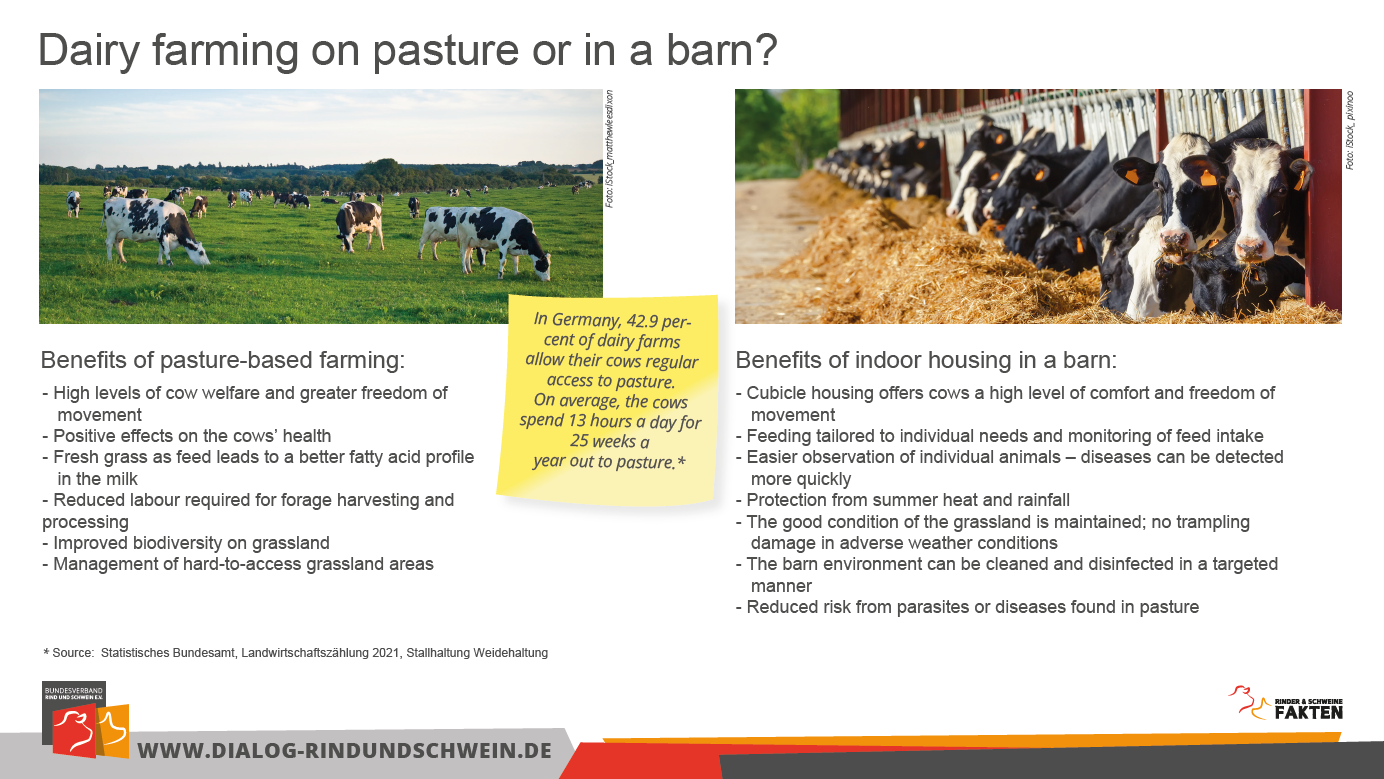
Both indoor and pasture-based rearing offer dairy cows various advantages. Pasture-based rearing allows the cows a great deal of freedom of movement and often contributes to a high level of welfare. This can have a positive effect on their health. The fresh grass in their diet also leads to a change in the fatty acid profile of the milk, which, for example, makes butter easier to spread. There are advantages for the farmer too: the effort involved in harvesting and processing feed is reduced, as the animals graze on the grass directly. Additional feed needs to be provided only during periods when the cows are kept in the barn, particularly at night or in winter. Professional pasture management is, of course, also labour-intensive and requires regular maintenance of the grassland, fences and the animals’ water supply.
However, grazing has a positive effect on biodiversity in grassland. It also allows land to be used that is difficult to access for other forms of farming.
In Germany, around 87 per cent of dairy cows are kept in loose-housings, and around 11.5 per cent in tie-stalls. In loose-housings, the animals can move about freely and decide for themselves whether they wish to stay in the cubicles, at the feeding table or in the walkways. Year-round indoor housing also has advantages for the animals. A stable nutritional status can be achieved through continuous, needs-based and individually tailored feeding. Furthermore, the barn protects against extreme weather conditions such as heat, rain or cold. Another advantage is that the farmer can monitor the animals more effectively. The barn environment can be specifically cleaned and disinfected, thereby reducing the risk of parasite or disease transmission, as occurs on pasture.
In practice, high-yielding dairy cows are usually only given partial access to pasture, for example for a few hours or half a day. They thus benefit both from the advantages of grazing and from controlled feeding and protection from the weather in the barn.
At the time of the last agricultural census in 2020, published by the Federal Statistical Office, there were 54,490 dairy farms in Germany with a total of around 3.96 million dairy cows. 42.9 per cent of these farms provided their animals with regular access to pasture. In terms of the total herd, this corresponds to 30.8 per cent of dairy cows. On average, grazing was provided for a period of 25 weeks per year, with a daily grazing duration of around 13 hours.
Significant differences were observed depending on farm size. As a general rule, the smaller the farm, the more frequently grazing was provided. In small herds of 10 to 19 cows, an average of 42.4 per cent of the animals were given regular access to pasture. On farms with more than 100 cows, this proportion stood at 36.1 per cent, whilst in herds with over 200 animals it fell to 17.6 per cent.
There were also significant regional differences. Grazing is particularly widespread in the north-western federal states. In North Rhine-Westphalia and Schleswig-Holstein, more than 50 per cent of dairy cows in each state had regular access to pasture. In Lower Saxony, Rhineland-Palatinate and Hesse, the proportion was over 40 per cent. The lowest figures were recorded in the eastern federal states: in Saxony-Anhalt, Saxony, Brandenburg and Thuringia, on average only around 10 per cent of dairy cows had regular access to pasture. This is mainly due to the significantly larger herds and the lack of suitably large areas of pasture in the immediate vicinity of the barns.


