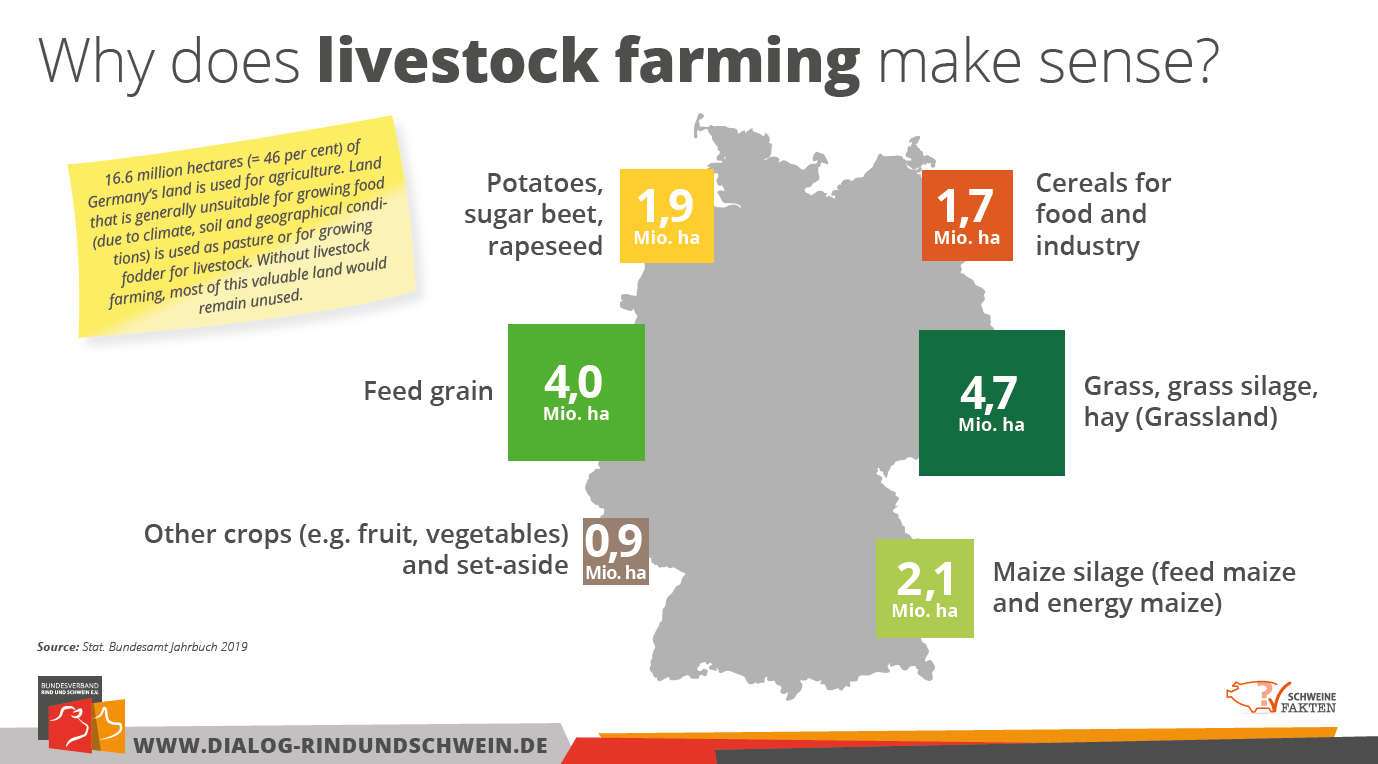
Livestock Farming: Making Efficient Use of Agricultural Land land in Germany is used for a variety of purposes. Of the country's 16.6 million hectares of agricultural land, substantial areas are used for producing animal feed. These include 4.7 million hectares of grassland used for grass, grass silage and hay, 2.1 million hectares for maize silage and other forage crops, and around 4 million hectares for feed grain. It is important to recognise that agricultural land varies considerably in its natural conditions and suitability for different crops. Much of the grassland cannot be used for arable farming due to soil conditions, climate or geographical factors. Even on arable land, however, not every crop can be grown successfully. Soil quality and local growing conditions determine which crops and varieties are suitable. Cereals grown on land that is less suitable for demanding food crops, such as bread wheat, can still be valuable as animal feed. Livestock farming therefore makes it possible to use grassland and parts of arable land for food production that are unsuitable, or less suitable, for growing food directly for human consumption. Livestock convert grass, plants and agricultural by-products that are not directly suitable for human nutrition into valuable food products such as milk and meat.